A sea like a mirror
Dawn is the flattest sea of the day: the board feels stable and beginners are standing within minutes.
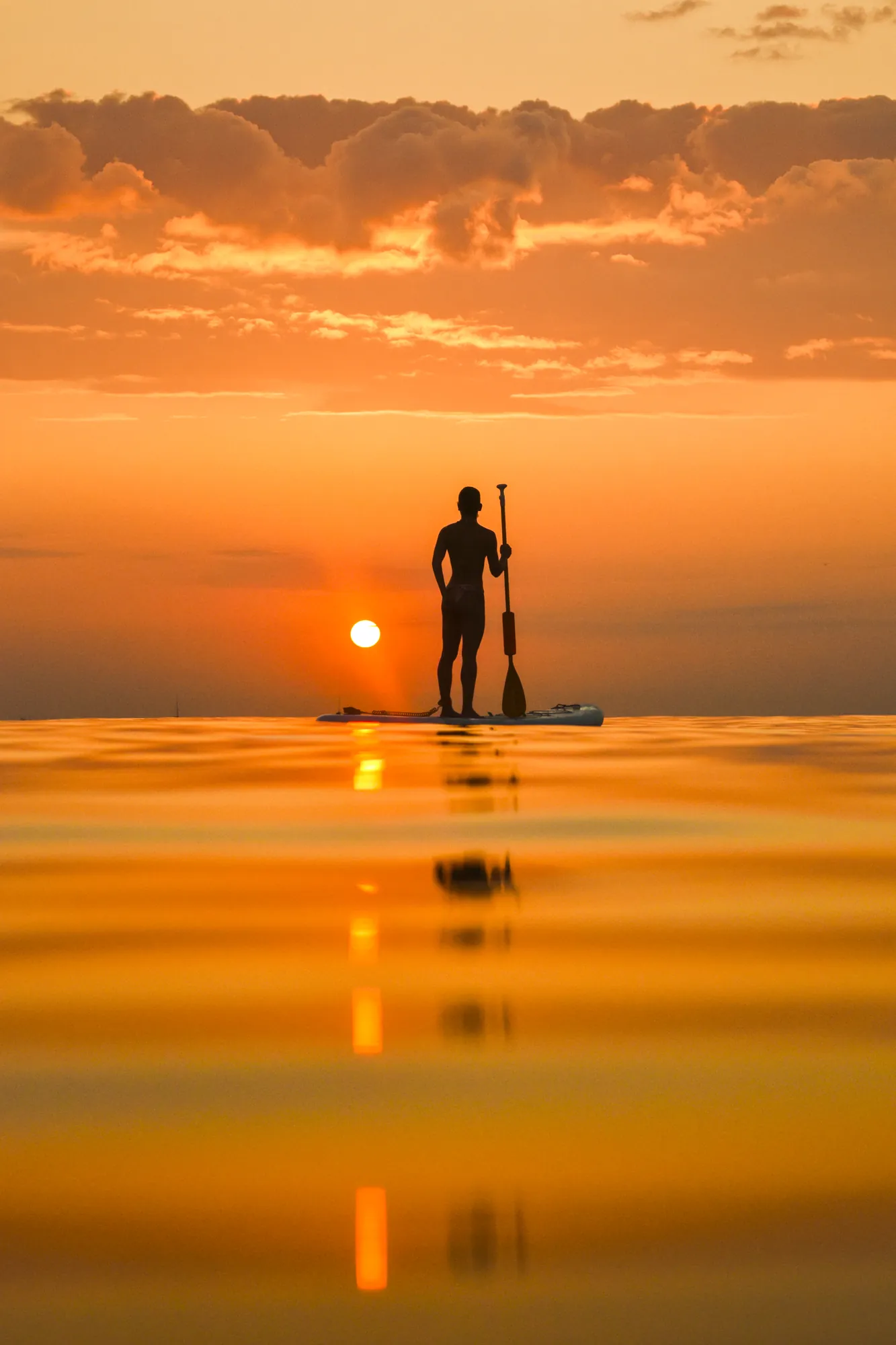
The sea like a mirror, the town still asleep, and the sun coming up over the open water with the silhouette of Sitges on the horizon. Small groups, certified guide and photos included. 35 €.
Looking for things to do in Sitges at sunrise? We settled that question years ago: paddle. Before the wind wakes up, the Mediterranean goes flat as a mirror and the town is still asleep. It is the best window of the whole day for paddle boarding in Sitges.
We meet at our base on Av. de la Mare de Déu de Montserrat, 62, in the quiet Vinyet–Terramar area. You pick up your board and gear and we all walk down together, about two minutes, 150 metres, to Platja de la Riera Xica, the beach right in front, tucked between l'Estanyol and Terramar on the residential side of Sitges, away from the busy town centre. And why does that matter? It changes everything. We paddle straight out into clean, open water: the sun comes up over an empty sea with the silhouette of Sitges' old town and church on the horizon. That is why our photos look the way they do, no swimmers, no crowds in the background, just you and the day beginning.
And because the water is that flat, sunrise is also the easiest time to learn stand up paddle. Most beginners are on their feet and gliding within minutes, with a certified local guide who reads the day's conditions and keeps the group small.
Every sunrise session is led by a certified instructor: the basics on the sand, an easy paddle out to calm open water, and photos of the whole thing. The photos are included and delivered fast, and your belongings stay safe at the base while you are on the water. If you are after a sunrise in Sitges people actually remember, this golden hour seen from the sea is the one they are still talking about when they get home.
Dawn is the flattest sea of the day: the board feels stable and beginners are standing within minutes.
The sun comes up straight out of the water, with the silhouette of Sitges' old town and church on the horizon.
Riera Xica sits on the residential side of Sitges, away from the busy town centre. The open water is all yours. Quite the luxury.
Open water, no crowds and the Sitges postcard skyline behind you, with photos included in every tour.
Every sunrise tour on the planet promises you the sun rising out of the sea. On this coast that is true for a good part of the year and simply not true for the rest, so here is the honest version.
Riera Xica faces south-southeast, and the coastline runs northeast to southwest. Stand on your board looking out to sea and the old town, with the church of Sant Bartomeu i Santa Tecla up on the rock of La Punta, is on your left, about a kilometre and a half away. Behind it the Garraf massif closes the horizon. Terramar and its low offshore islets are on your right. Straight ahead there is nothing but open water.
The point where the sun appears travels a long way across that view during the year: from roughly 57 degrees in midsummer, which is well inland behind the mountain, round to about 121 degrees at midwinter, which is far out over the water to your left. That gives you two genuinely different sunrises.
From late August through to the third week of April, the sun clears the land and lifts straight out of the open sea. That is the postcard one, and the end of August is the pick of the year: the sun comes up almost exactly in line with La Punta, so it rises out of the water right beside the silhouette of the church.
From late April to late August, it rises behind the Garraf massif and the old town instead. You do not get a disc emerging from the water. You get the ridge turning incandescent, the town in black silhouette, the whole bay glowing before the sun itself shows up — and in June, because it has to climb a ridge ten to fourteen kilometres away, it appears a few minutes later than the official sunrise time. That is one of the reasons we set the meeting time by the season rather than by the clock.
It is not luck, it is the local wind cycle. Overnight and into the early morning a light land breeze comes down off the hills, the terral, and because it has almost no run over the water it flattens the surface instead of building it. Then from April to October the sea breeze arrives, the marinada, usually between eleven and one, swinging round to the southwest as the garbí and peaking through the middle of the afternoon. That breeze puts twenty to forty centimetres of chop on the sea and turns the paddle back into work. So the flat window is real, it is predictable, and it belongs to whoever gets up early.
There is one wind we watch harder than the rest: a strong offshore mestral or ponent, blowing off the land from the northwest or west. It leaves the sea looking like glass near the shore, which is exactly the trap, because it pushes you away from the beach and makes the return brutal. On those mornings your guide changes the route or the time. That call is not up for negotiation, and it is the main thing a local guide is for.
On a paddle board you are standing up and mostly dry, so the sea temperature matters less than people expect. At dawn, what really decides how you dress is the air and the breeze.
Monthly averages on this stretch of coast run from around 26 °C in August down to about 13 °C in February, and recent summers have been warmer than those historical averages, with August water sitting well up in the twenties. In practice:
The rule we work to: below 18 °C everybody wears a wetsuit, between 18 and 21 °C a shorty does the job, above that nothing at all. Wetsuits are part of the tour in the cooler months at no extra cost. What you bring is a warm layer and something dry to change into afterwards, because at half past six in November the air bites long before the water does.
This is what the photos you take home as a gift look like, on every sunrise tour. Can you see yourself out there?
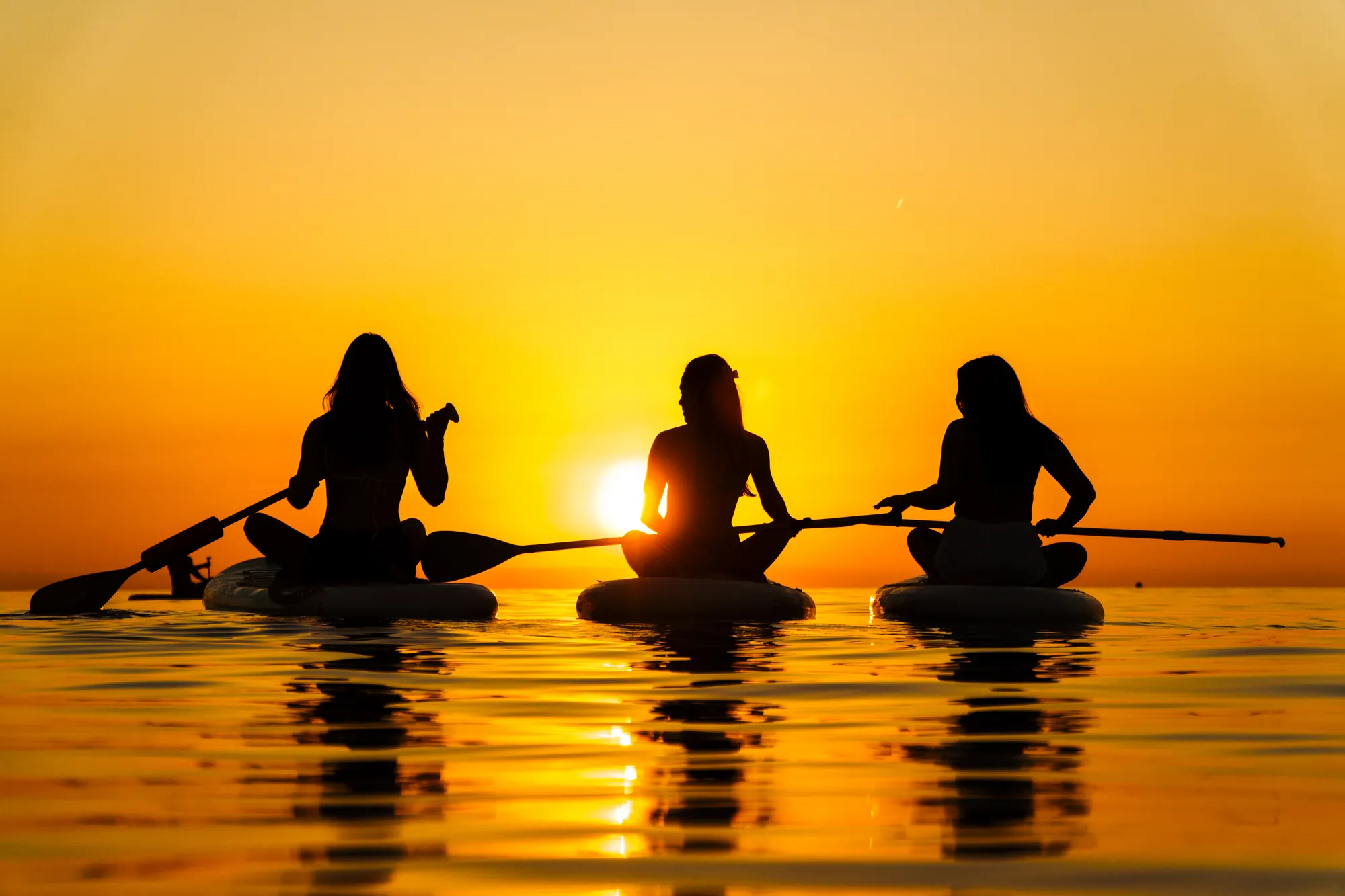
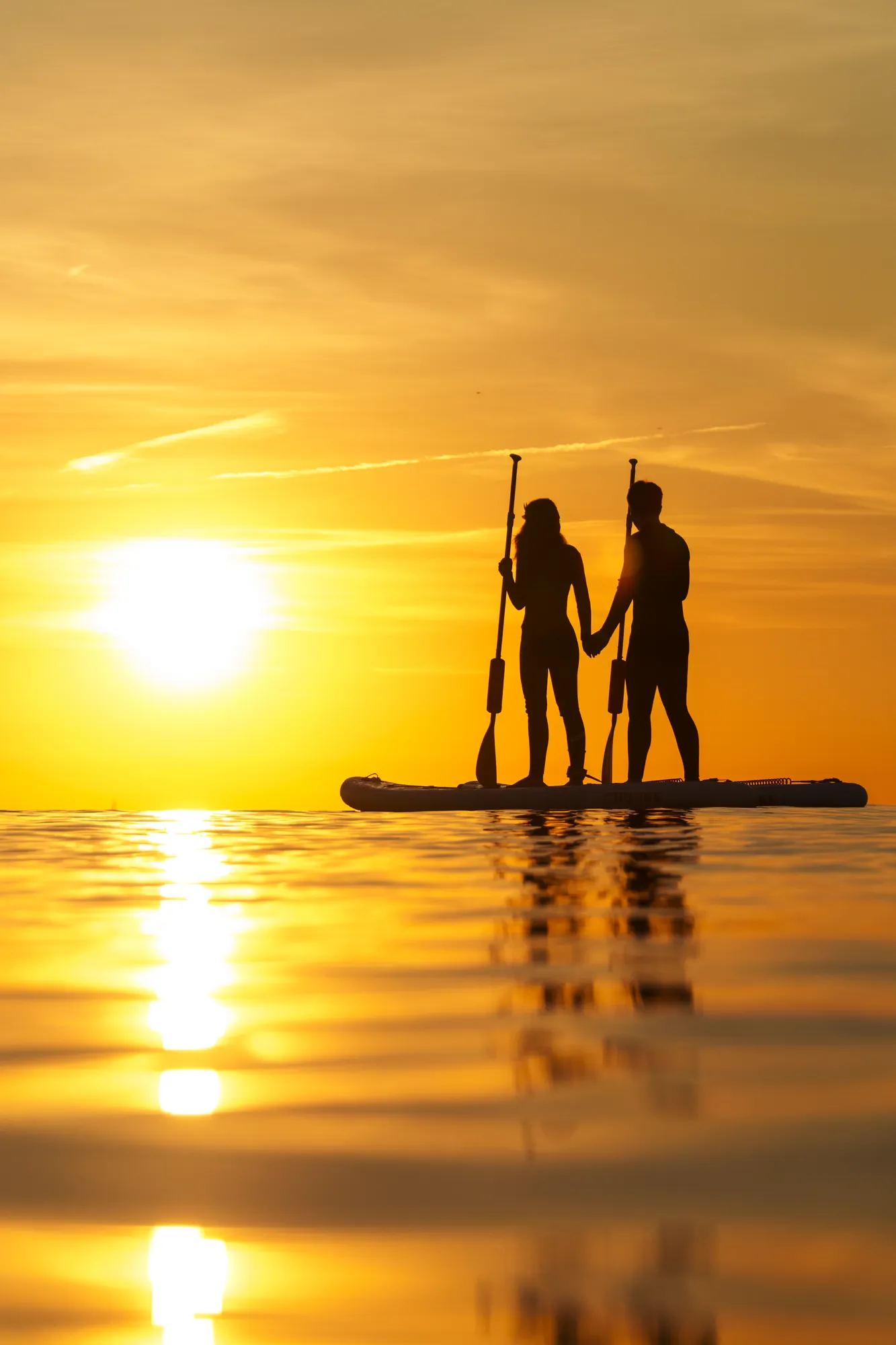
We launch at first light, so the exact time moves with the season: roughly between 5:45 and 7:45. An early alarm, yes. What do you get in return? The flattest water and the best light of the whole day.
At our base: Av. de la Mare de Déu de Montserrat, 62, 08870 Sitges. You pick up your board and gear there and we all walk down together — about 2 minutes, 150 m — to Platja de la Riera Xica, the beach right in front. Your belongings stay safe at the base while you paddle.
No, and it is actually the easiest time to learn: the sea is like a mirror and most people feel stable on the board within minutes. Before you get in, your certified instructor covers the basics on the sand.
Yes, they come as a gift. Riera Xica is a quiet beach on the residential side of Sitges, so your photos come back with open water and the silhouette of the old town and church on the horizon: no swimmers, no crowds in the frame, just you and the sunrise.
Being comfortable in the water is enough. You wear a leash that keeps you attached to the board at all times and your guide always paddles close by.
A swimsuit, a towel, sunscreen and the will to get up early. We take care of the rest: board, paddle, leash and a wetsuit in the cooler months. Your belongings stay safe at the base while you are on the water.
35 € per person, with equipment, certified guide and photos included. Message us on WhatsApp with your day; groups are small and spots are limited.
Straight answer: not for the earliest departures. The first train of the day leaves Barcelona Sants at 05:45 and reaches Sitges at 06:23, and from the station you still need 25 to 30 minutes on foot or a short taxi ride. So if we are launching before seven, come by car — 40 kilometres on the C-32, around 45 minutes with empty roads — take a taxi from the station, or sleep in Sitges the night before. For departures at 07:30 or 07:45 the train works fine. At weekends and on public holidays take the train that arrives at 06:38, because one of the early services does not run.
Right outside, and for free. Our street is inside the regulated zone of Vinyet, but it only charges from 10:00 to 14:00 and from 16:00 to 20:00, so at sunrise the street is both free and empty. If you stay on into the morning, the blue zone costs 1.35 € an hour with a three-hour maximum, payable at the meter or by app. From about eleven in high summer, finding a space 150 metres from the beach gets genuinely hard.
If your departure is before seven, yes: it turns a logistics puzzle into a five-minute walk. It also solves the timetable problem, because no train arrives in Sitges between 00:44 and 06:23. And if you get here the evening before and want a taxi in the morning, book it the night before — at 06:23 there is not always one waiting on the rank at the station.
We are usually off the water around half past eight, when most of the town is still shut. The municipal market opens at 8:30 from Monday to Saturday and is the best early option, with coffee and something fresh among people doing their shopping. From there the seafront promenade takes you into the centre in about twenty flat minutes, past the chiringuito that has been on that sand since 1913, the first one in Spain. If you want to make a morning of it, the Cau Ferrat and Maricel museums open at 10:00 and close on Mondays.
From the base to the open water, step by step and at your own pace.
A sunrise paddle boarding session in Sitges starts at our base on Av. de la Mare de Déu de Montserrat, 62, before the sun is fully up. You pick up your board and gear, leave your belongings safely at the base, and we all walk down together — about two minutes, 150 metres — to Platja de la Riera Xica, the beach right in front. Your certified guide runs a short briefing on the sand: how to get on the board, how to paddle and how to keep your balance. Then we paddle out together into clean, open water as the sky turns gold.
From there it is all about the moment: gliding over a flat sea, watching the sun come up over the open water with the silhouette of Sitges behind you, and stopping for the photos that end up making the whole trip. We keep groups small so the pace stays relaxed and the guide stays close.
It is the experience that only exists at first light, perfect for couples, friends, beginners and anyone after a different way to see Sitges. Message us on WhatsApp with your day and we confirm right away.
Tell us your day and we confirm your sunrise spot right away. Small groups, limited spots.
💬 Book on WhatsAppPrefer a call or an email?
+34 687 588 670 · [email protected]
Message us on WhatsApp with your day. Small groups, certified guide and photos included, 35 €.