Golden hour light
Warm, soft light towards Terramar as the sun drops behind the Garraf, the most photogenic moment of the day.
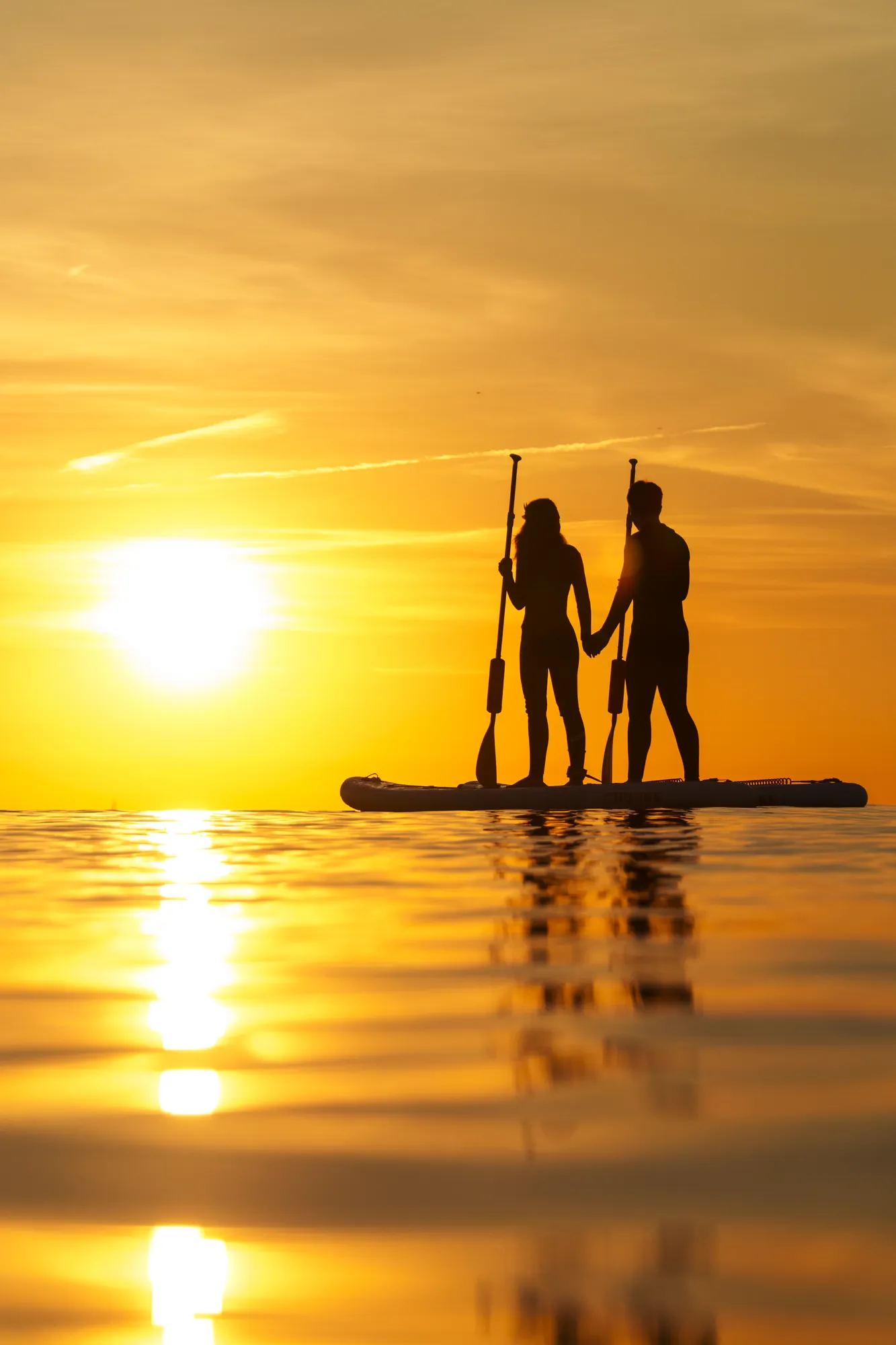
Where is the best place to watch the sunset in Sitges? The water. Paddle through golden light towards Terramar as the sun drops behind the Garraf. Certified guide and photos included. 35 €.
Looking for things to do in Sitges in the evening? This one starts as the day winds down: the sea softens, the light turns gold towards Terramar and the town glows behind you. It is the warmest, most relaxed hour for paddle boarding at Platja de la Riera Xica.
We meet at our base on Av. de la Mare de Déu de Montserrat, 62, in the quiet Vinyet–Terramar area. You pick up your board and gear and we all walk down together, about two minutes, 150 metres, to Platja de la Riera Xica, the beach right in front, between l'Estanyol and Terramar on the residential side of Sitges, away from the busy town centre. From there we paddle out into calm, open water. Watching the Sitges sunset from the sea, with golden light spilling over Terramar and the Garraf coastline, is the most photogenic moment of the day, and that is exactly why our sunset photos look the way they do.
Never stood on a board before? Even better. The evening sea is usually gentle, so sunset is just as beginner friendly as sunrise. A certified local guide reads the conditions, keeps the group small and has everyone steady on the board within minutes.
Every sunset session is led by a certified instructor: the basics on the sand, an easy glide through the golden hour and photos of the session, included. It works beautifully as a plan for couples and just as well with a group of friends. Prefer a sea like a mirror and the town still asleep? Have a look at the sunrise paddle boarding tour.
Warm, soft light towards Terramar as the sun drops behind the Garraf, the most photogenic moment of the day.
The evening sea is gentle and the air stays warm: an easy, relaxed paddle for any level.
We keep groups small so the pace stays easy and your guide is always close by.
Open water, a quiet beach and the Garraf coastline glowing gold behind you, with photos included.
You will read all over the internet that in Sitges you can watch the sun sink into the sea. You cannot, not for most of the year, and we would rather tell you before you book than after. What you get instead is better than the cliché — but it is a different thing, so let us describe it properly.
The whole Sitges seafront looks south-southeast. That single fact decides everything: the sun never goes down in front of you, it drops away over your right shoulder, over land. Its setting point travels from about 302 degrees at midsummer, west-northwest and clearly inland, round to roughly 239 degrees in the depths of winter. Meanwhile the coast itself keeps running away westwards: Vilanova i la Geltrú sits at 248 degrees, not quite six kilometres off, with Cubelles behind it and, on a clear day, Calafell beyond that.
Put the two together and the answer is simple. For most of the year the sun sets behind land: the western hills of the Garraf in summer, the far coastline in spring and autumn. Only from around the beginning of November to early February does it actually go down over open water, and even then it is grazing the distant Costa Daurada rather than dropping into an empty horizon.
Raking light, which is the thing photographers set their alarms for. Over the last hour the whole scene turns: the Garraf ridge and the silhouette of the church on La Punta go gold, then copper, then pink, while the sky over the water behind them fills with colour. You are not staring at the sun, you are watching what the sun does to the town — and because you are floating a couple of hundred metres offshore, you have the only seat in Sitges with that particular view. It happens every evening of the year, in November as much as in July, which is more than can be said for any sunset that depends on a clean horizon.
The other half of it is behind you on the paddle back in. As the light drops, the surface takes the colour of the sky and goes pale gold, then silver, then grey-blue. It is the softest hour on this water, and it is the reason we put the boards out then instead of in the middle of the afternoon.
There is a reason nobody local plans anything on the water at four in the afternoon in July. It is called the garbí, and the whole coast organises its day around it.
From April to October the sea breeze builds almost every day. It comes in somewhere between eleven and one, swings round to the southwest as the afternoon goes on and peaks from midday through mid-afternoon, putting twenty to forty centimetres of short chop on the water exactly when the beach is at its fullest. Then, as the land cools and the temperature difference that feeds it collapses, the breeze fades and the sea settles again for the last hours of light. That is the window we paddle in.
It is a slightly different calm from the one at dawn. At first light the sea has had all night to settle and it goes genuinely mirror flat; in the evening it keeps a little of the texture the afternoon left behind, so you may find a gentle ripple rather than glass. For paddling it changes nothing — beginners are up and moving within minutes either way — but we would rather describe it accurately than promise you a mirror.
Two things can move a sunset session. The first is a strong offshore wind coming off the land from the west or northwest: it flattens the water near the shore, which is exactly what makes it dangerous, because it then pushes you away from the beach. Your guide will change the route or the time rather than take a group into that. The second is an easterly, the llevant, which is the wind that builds real waves on this coast and the one that carries the sand away from these beaches. When it is blowing properly we reschedule, and you get another evening.
From June to October the sea sits between 22 and 26 °C and you paddle in a swimsuit, no wetsuit needed. What people forget is what happens after the light goes: the air cools fast, so bring a jumper or a windproof for the walk back up to the base. It is only two minutes, but it is two minutes wet. In spring and autumn, with the water nearer 15 to 18 °C, a wetsuit comes with the tour at no extra cost.
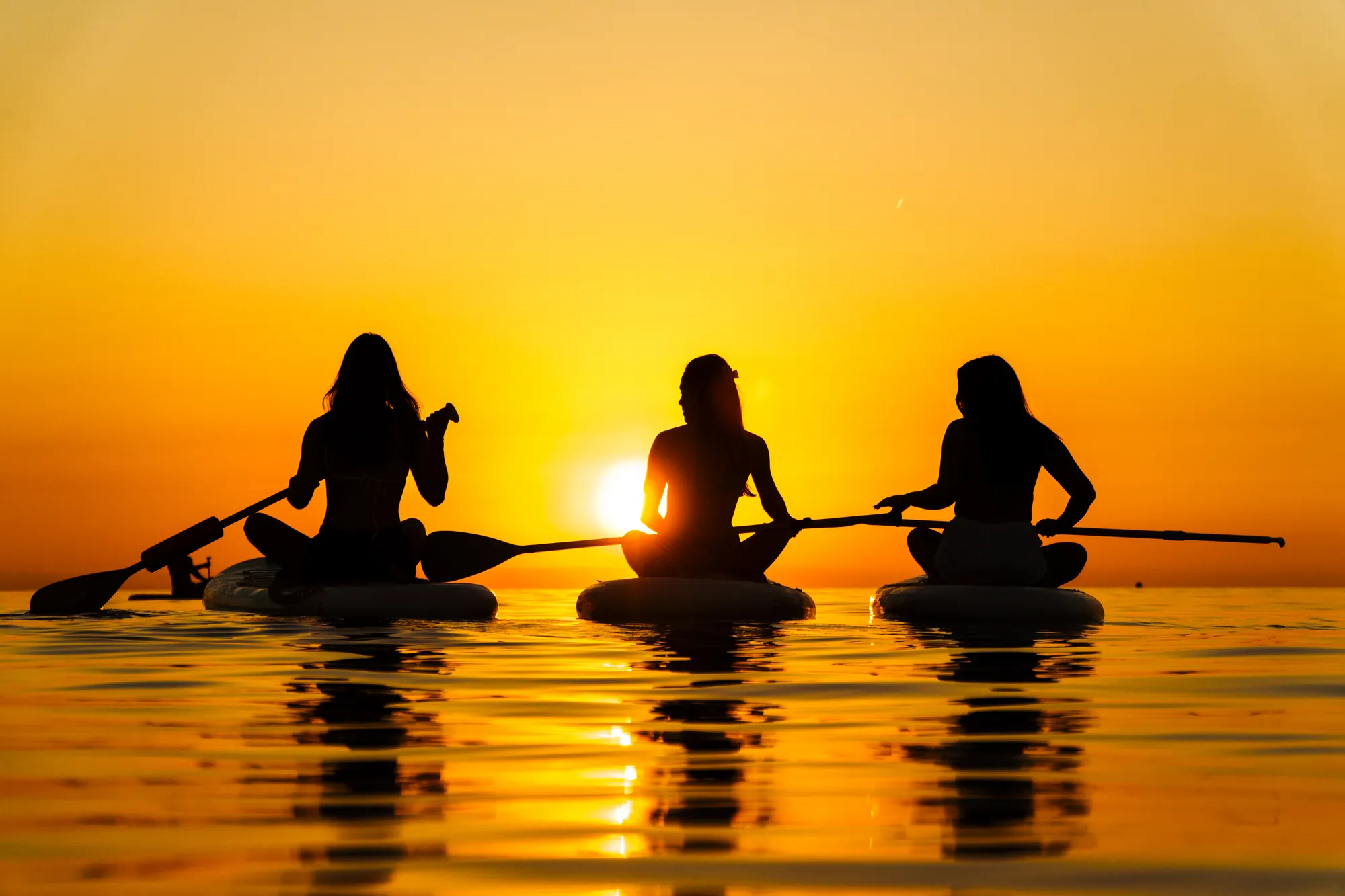
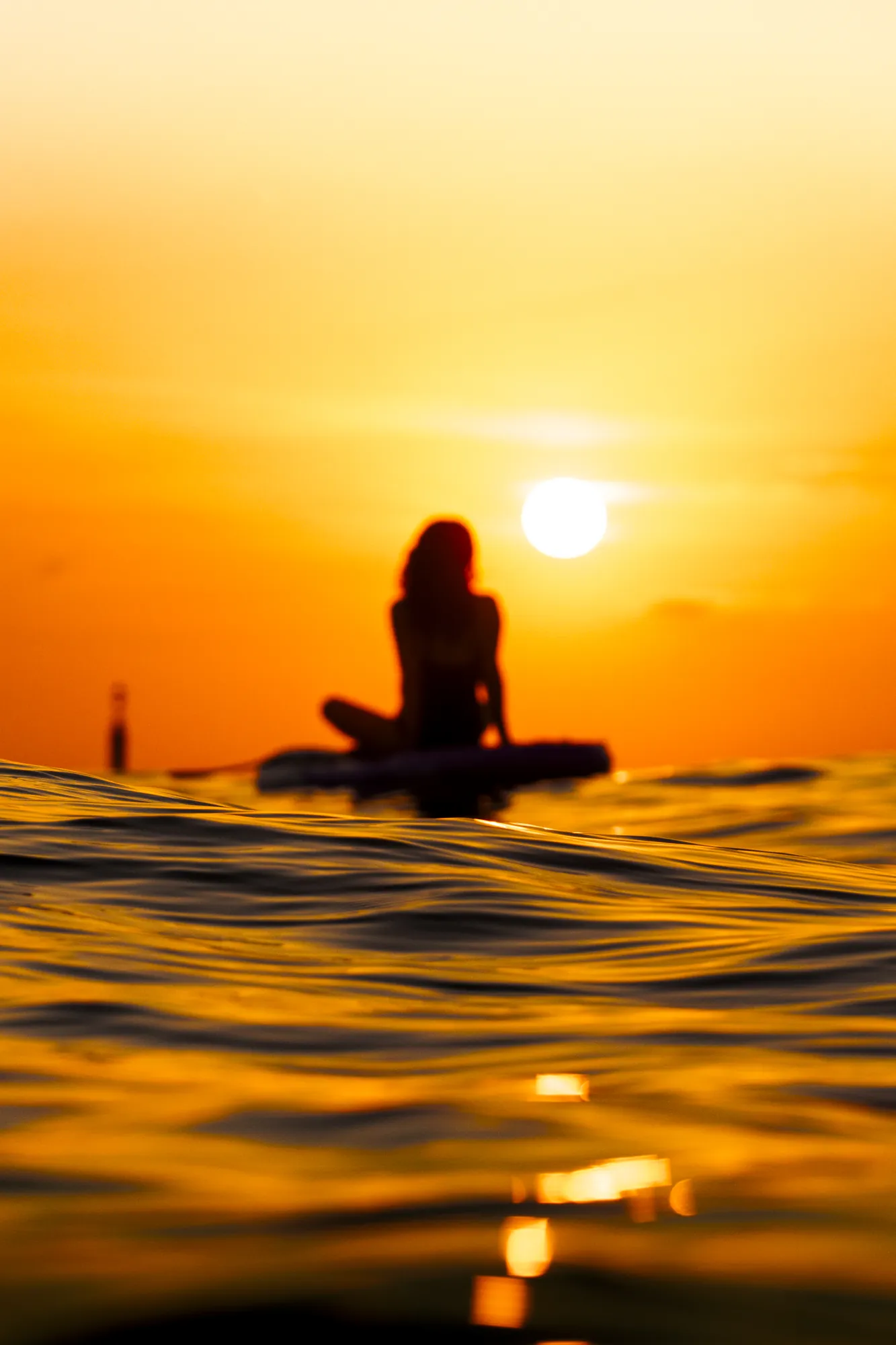
This is what the photos you take home as a gift look like, on every sunset tour. Can you see yourself out there?
We head out so you are on the water for the golden hour: roughly between 19:30 and 21:00, depending on the season and when the sun sets. We confirm the exact time when you book on WhatsApp.
At our base: Av. de la Mare de Déu de Montserrat, 62, 08870 Sitges. You pick up your board and gear there and we all walk down together — about 2 minutes, 150 m — to Platja de la Riera Xica, the beach right in front. Your belongings stay safe at the base while you paddle.
No. The evening sea is usually calm and your certified instructor covers the basics on the sand before you get in, so beginners are paddling within minutes.
Yes, they come as a gift: you paddling in golden hour light towards Terramar, with the sun setting behind the Garraf coastline.
A swimsuit, a towel and sunscreen. We take care of the rest: board, paddle, leash and a wetsuit in the cooler months. Your belongings stay safe at the base while you are on the water.
35 € per person, with equipment, certified guide and photos included. Message us on WhatsApp with your day; groups are small and spots are limited.
Yes. We time the launch so that you are already on the water for the golden hour, and here the light lingers well after the sun has gone behind the hills to the west: the ridge and the town keep glowing, and the sea holds the colour of the sky for a good while longer. We are back on the sand with light to spare, which is also when the last photos tend to be the best ones.
Usually a little more textured, yes. From April to October the afternoon sea breeze, the garbí, comes in around midday and blows from the southwest until it fades with the heat, and it leaves some ripple behind. By the time we launch it has normally dropped away. It makes no practical difference for a beginner, and if the breeze has not eased your guide adjusts the route or the time.
The evening tour is the easy one to reach. The R2 Sud train takes 32 to 38 minutes from Barcelona Sants, with around four trains an hour during the day and a ticket at about five euros; from Sitges station it is 25 to 30 flat minutes on foot along the seafront, or six to eight minutes by taxi from the rank at the station. By car it is 40 kilometres on the C-32 through the Garraf tunnels, still a toll road at 8.42 € each way. Street parking around us is charged until 20:00, at 1.35 € an hour in the blue zone, and free after that.
Dinner, mostly. The old town and the restaurants along the Passeig de la Ribera are a flat 25 to 30 minute walk along the seafront, or a short taxi ride, and everything opens late in summer. If you are heading back to Barcelona the same night, check the last departure for the day you are travelling, because the timetable shifts with the season; by car it is around 45 minutes back to the city on a clear road.
From the base to the golden hour, step by step and at your own pace.
A sunset paddle boarding session in Sitges starts at our base on Av. de la Mare de Déu de Montserrat, 62, in the early evening. You pick up your board and gear, leave your belongings safely at the base, and we all walk down together — about two minutes, 150 metres — to Platja de la Riera Xica, the beach right in front. Your certified guide runs a short briefing on the sand, then leads you out into clean, open water just as the light turns gold.
You glide over the calm evening sea while the sun drops behind the Garraf and the light washes over Terramar, and we stop for photos at the best moment. Small groups keep the pace relaxed and the guide close.
It is the perfect end to a day in Sitges, ideal for couples, friends and beginners. Message us on WhatsApp with your day and we confirm right away.
Tell us your day and we confirm your sunset spot right away. Small groups, limited spots.
💬 Book on WhatsAppPrefer a call or an email?
+34 687 588 670 · [email protected]
Message us on WhatsApp with your day. Small groups, certified guide, photos included, 35 €.